
When it comes to removable partial dentures, every case is different. Patients want a solution that looks natural, feels comfortable and fits well, while dentists need a prosthesis that provides reliable retention, function, and long-term performance.
Advances in digital dentistry are creating new possibilities in removable prosthetics. One of these is 3D-printed flexible partial dentures, including solutions such as SprintRay Apex Flex, which offer an alternative approach for selected clinical situations.
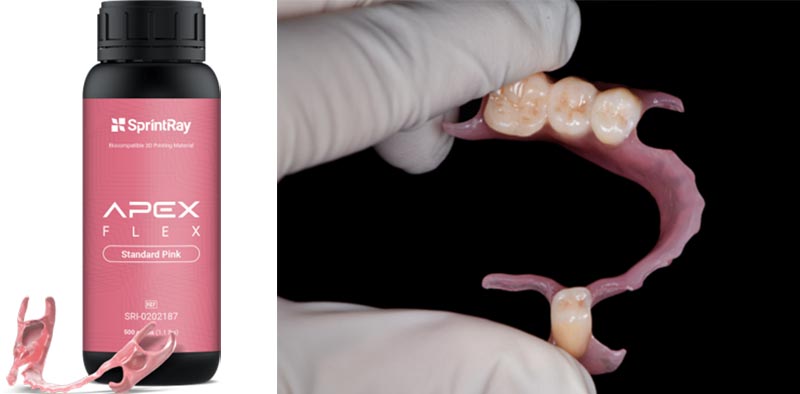
A More Discreet Approach to Removable Prosthetics
One of the main reasons to consider a flexible partial denture is aesthetics. Traditional cobalt-chromium frameworks are strong and well established, but their metal clasps may be visible when a patient smiles or speaks.
Flexible dentures offer a different approach, with tooth-coloured or gingiva-coloured components that can blend more naturally with the surrounding tissues, depending on the design and material selected.
For patients who are particularly concerned about the appearance of their removable prosthesis, this can be an important advantage.
However, aesthetics should always be considered alongside function, stability and the patient’s individual clinical needs.
What Does 3D Printing Bring to the Process?
Digital design and 3D printing allow the dental team to plan and manufacture a prosthesis through a controlled digital workflow. This can support consistency, reproducibility and communication between the dental practice and the laboratory.
With a material such as SprintRay Apex Flex, the aim is to combine the benefits of a flexible design with the precision of a digital manufacturing process.
As with any dental material, the final result depends on more than the printing technology alone. Accurate records, appropriate case selection, careful design, correct post-processing and clinical assessment all play an important role.
Flexible Resin, Polyamide or Cobalt-Chromium?
Although these options may all be used for removable prosthetics, they are not interchangeable.
Flexible 3D-printed resin can be a useful option when aesthetics and flexibility are priorities. Its suitability depends on the material’s approved indications and the design requirements of the case.
Polyamide, often referred to as nylon, is another material used for flexible dentures. Its handling, adjustment, polishing and repair characteristics differ from those of printed photopolymer resins.
Cobalt-chromium frameworks remain an important choice when rigidity, positive support and established removable partial denture design principles are required. Features such as rests, guide planes and reciprocating elements can help control movement and distribute forces.
The choice should therefore be based on the clinical situation rather than on the assumption that one material is always better than another.
Why Design and Case Selection Matter
Flexibility can be an advantage, but it also changes how a prosthesis behaves under load. The position and shape of clasp arms, the amount of undercut engaged and the overall framework design all influence retention and performance.
A flexible partial denture is not simply a conventional metal framework made from a softer material. It requires a design that takes the properties of that particular material into account.
Cases with limited restorative space (less than 4mm interocclusal space, unfavourable ridge anatomy (Kennedy class I with severe atrophy), a deep overbite, significant tooth wear or parafunctional habits may require additional consideration. In some situations, a more rigid framework or a different treatment approach may be more appropriate.
These factors should be assessed individually, taking into account the patient’s occlusion, remaining teeth, periodontal condition, ridge anatomy and functional requirements.
Looking Beyond Aesthetics
A successful removable partial denture needs to do more than look good. It should provide suitable retention, be comfortable to wear and maintain its function within the limitations of the chosen material and design.
Patients should also receive clear instructions on insertion and removal, cleaning and maintenance. Follow-up appointments allow the dentist to assess fit, tissue health, retention and any areas requiring adjustment.
It is equally important to follow the manufacturer’s instructions for the specific material, including its indications, manufacturing parameters and post-processing requirements.
Working Together for Better Outcomes
At our dental laboratory, we believe that good results start with choosing the right solution for the right patient. Flexible 3D-printed partial dentures can offer an additional option within modern removable prosthetics, but they should be selected as part of a considered treatment plan.
By working closely with dentists, we can assess the case requirements, discuss material options and develop a design that reflects the patient’s needs and the clinical objectives.
The best partial denture is not necessarily the most flexible or the most rigid one. It is the one that is appropriately designed for the individual patient.


